
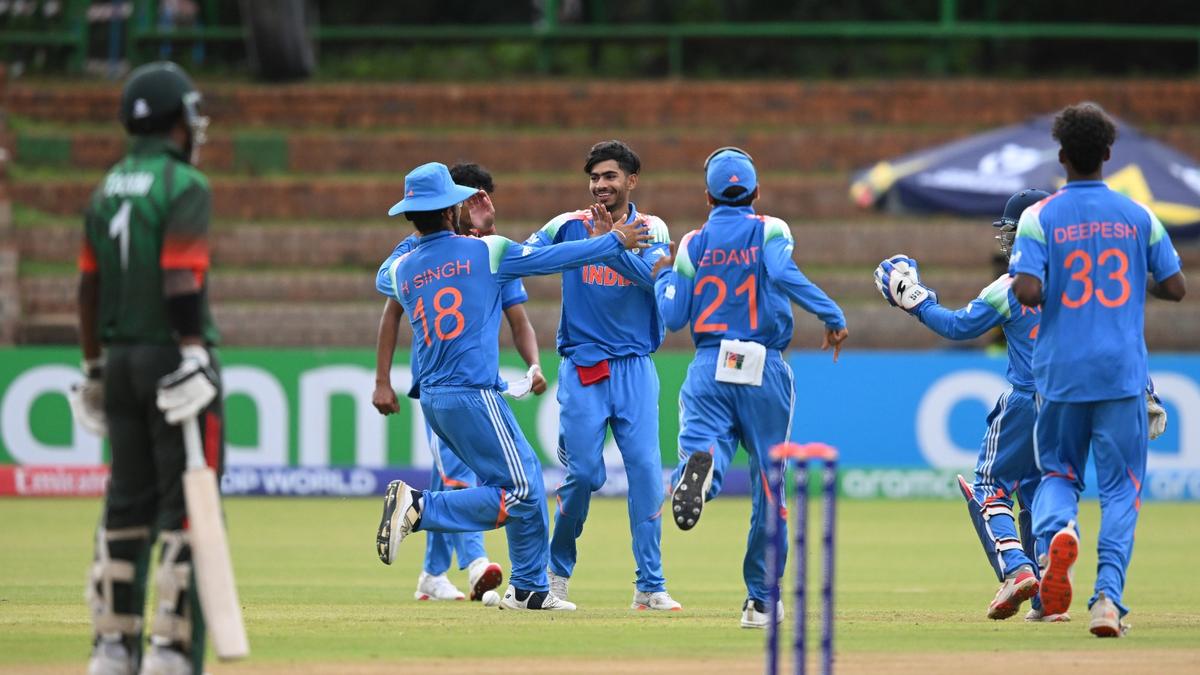
At the Queens Sports Club in Bulawayo, where clouds hovered ominously and rain repeatedly threatened to dictate terms, India Under-19 produced a stirring all-round performance to defeat Bangladesh Under-19 by 18 runs (DLS method) in a rain-curtailed ICC U-19 World Cup 2026 encounter on Saturday, January 17. The contest ebbed and flowed with momentum swings, interruptions, and tactical recalculations, but at its heart lay a standout individual display—Vihaan Malhotra’s brilliant four-wicket haul—that tilted a chaotic game decisively in India’s favour.
It was India’s second consecutive victory in the tournament, reinforcing their status as one of the early frontrunners, while Bangladesh were left to rue missed opportunities in a match where conditions, composure, and clarity proved equally important as skill.
A Stop-Start Beginning: Rain Looms Before a Ball Is Bowled
The day began under uncertain skies. Persistent drizzle delayed the toss, setting the tone for what would become a fragmented contest. Eventually, when the rain relented and conditions improved just enough to start, Bangladesh captain Azizul Hakim Tamim opted to bowl first—an understandable decision given the moisture in the pitch and the overhead conditions at Bulawayo.
India, led by Ayush Mhatre, entered the match as favourites, buoyed by their opening victory over USA. Bangladesh, however, carried confidence from recent youth tournaments, including their triumph over India in the U-19 Asia Cup final in 2024. The stage was set for a keenly contested encounter, even if nature had other ideas.
Early Collapse: Bangladesh Strike Hard with the New Ball
India’s innings got off to a nightmare start. Al Fahad, extracting movement off the seam, bowled a probing maiden to open proceedings. The pressure told almost immediately. Vedant Trivedi fell for a first-ball duck, edging to slip, before Ayush Mhatre’s struggles at the U-19 level continued. The Indian captain, desperate for a defining knock after a lean run in Youth ODIs, cut loosely at a back-of-a-length delivery and was caught in the covers.
At 12 for 2 and then 25 for 3, India were wobbling badly. Bangladesh’s bowlers were relentless, keeping the field tight and forcing errors through sustained discipline. Iqbal Hossain Emon and Al Fahad set the tone, while off-spinner Sheikh Parvez Jibon provided control during the PowerPlay.
Suryavanshi’s Counterattack: A Knock of Courage and Class
In the midst of the early collapse, Vaibhav Suryavanshi emerged as India’s aggressor-in-chief. Unfazed by the fall of wickets around him, the left-hander played with intent and clarity, picking his scoring areas intelligently. His innings was a blend of audacity and timing—upper cuts over the slip cordon, powerful pulls, and clean lofted shots over the off side.
Suryavanshi raced to a half-century off just 30 balls, injecting much-needed momentum into India’s innings. Crucially, he forced Bangladesh to spread the field earlier than they would have liked, easing some of the pressure on the incoming batters.
At the other end, Abhigyan Kundu began circumspectly. For a long period, he struggled to rotate strike, crawling to 2 off his first 21 deliveries. Bangladesh’s bowlers sensed an opportunity to squeeze further, but Kundu’s resilience would later prove invaluable.
Middle-Overs Slog: Bangladesh Apply the Squeeze
Once Suryavanshi settled, Bangladesh responded by tightening their lines. Captain Azizul Hakim brought himself into the attack, bowling with remarkable control. His spell was less about wickets and more about strangulation, forcing India into a prolonged phase of consolidation.
The pressure eventually told. In the 27th over, Iqbal Hossain Emon struck a decisive blow, as Suryavanshi, attempting to break free, holed out to cow corner for a well-made 72 off 67 balls. It was a turning point—India lost its most fluent batter, and Bangladesh sensed an opening to run through the middle order.
Harvansh Pangalia fell cheaply, and wickets continued to tumble at regular intervals. The innings threatened to unravel completely, but Kundu, gradually finding his rhythm, stood firm.
Kundu Holds the Fort: A Crucial Anchor
Abhigyan Kundu’s innings was the antithesis of Suryavanshi’s flamboyance, yet no less important. Absorbing pressure, weathering close calls—including a missed stumping and a dropped catch—Kundu grew in confidence as the innings progressed.
He brought up a gritty half-century in the 37th over and then began to accelerate, playing calculated strokes down the ground and over square leg. His 80 off 112 balls was a study in temperament, ensuring India had something tangible to defend.
Lower down the order, brief cameos from Kanishk Chouhan and Deepesh Devendran nudged India past the 230 mark. Eventually, India were bowled out for 238 in 48.4 overs (later adjusted to 239 from 49 overs), a competitive total given the conditions and early setbacks.
Al Fahad was the standout for Bangladesh, returning superb figures of 5 for 38—an effort that deserved a winning cause.
Rain Returns, Overs Reduced, Pressure Mounts
As Bangladesh prepared to begin their chase, rain returned, delaying proceedings and reducing the match to 49 overs per side. The interruptions made the Duckworth-Lewis-Stern (DLS) calculations a constant subplot, adding layers of complexity for both teams.
When play finally resumed, Bangladesh’s openers Rifat Beg and Zawad Abrar started positively. However, India struck early. Deepesh Devendran removed Zawad, who edged a wide delivery to deep third, preventing Bangladesh from building unchecked momentum.
Captain Azizul Hakim joined Rifat and immediately looked assured, playing crisp strokes off both front and back foot. Bangladesh navigated the PowerPlay with confidence, reaching 54 for 1 after 10 overs and staying well ahead of the DLS par score.
Hakim Takes Charge: Bangladesh in Control
The partnership between Hakim and Rifat flourished. Rifat, in particular, was impressive, mixing aggression with smart placement. His 37 off 37 balls included a sublime pull for six and a series of well-timed boundaries through the off side.
India’s bowlers struggled to make inroads. Changes came and went, but Bangladesh continued to tick along. When Rifat finally fell—edging Kanishk Chouhan to the keeper—it only briefly slowed the chase. At 63 for 2 after 12 overs, Bangladesh were firmly in command.
Rain again hovered threateningly, and the equation was simple: if play were abandoned after 20 overs, Bangladesh would win on DLS. This reality influenced tactics on both sides. India slowed the game where possible, while Bangladesh faced a dilemma—bat conservatively to stay ahead of par or accelerate and risk wickets.
The Turning Point: Vihaan Malhotra Enters the Fray
The match swung dramatically in the 22nd over when Ayush Mhatre introduced Vihaan Malhotra into the attack. Until then, Malhotra had contributed little with the bat, but with the ball, he transformed the contest.
His very first over brought a breakthrough. Kalam Siddiki, attempting to take on the short delivery, top-edged a catch that Malhotra completed himself. The wicket shifted momentum instantly.
From there, Malhotra grew in confidence, bowling with remarkable accuracy and composure beyond his years. Sheikh Parvez Jibon fell next, holing out to long-on, and suddenly Bangladesh found themselves slipping behind the DLS par score.
Rain, Revised Target, Rising Tension
Another rain interruption reduced the chase to 29 overs, with Bangladesh set a revised target of 165. When play resumed, the equation read: 75 runs needed from 69 balls with eight wickets in hand. On paper, Bangladesh still had the advantage.
But cricket, especially under pressure, is rarely played on paper.
India sensed an opening and tightened the noose. Fielding intensity lifted noticeably. Every single was contested, every boundary fiercely protected. The psychological shift was palpable.
Malhotra’s Magic Spell: A Match-Winning Four-For
What followed was a masterclass in pressure bowling. Vihaan Malhotra struck again to remove Bangladesh captain Azizul Hakim, who had played a fine knock of 51 off 72 balls. The dismissal—a mistimed full toss picked out at long-on—was a hammer blow.
With Hakim gone, Bangladesh’s resolve crumbled. Malhotra removed Samiun Basir with a stunning relay catch taken by Suryavanshi at the boundary. Then came the wicket of Rizan Hossain, who holed out while attempting a desperate big hit.
Malhotra finished with four wickets, each one arriving at a crucial juncture. His figures did not merely reflect skill but also temperament—the ability to deliver under immense pressure, with rain, revised targets, and shifting momentum all at play.
Dramatic Finish: Fielding Seals the Deal
As the target narrowed, Bangladesh’s lower order tried valiantly to keep hopes alive, but India’s fielding rose to the occasion. Run-outs, diving stops, and sharp catches underlined a collective commitment that has long been a hallmark of successful Indian youth sides.
The final act was fittingly dramatic. With Bangladesh 146 all out in 28.3 overs, Emon attempted a desperate scoop, only to see Vihaan Malhotra fling himself at long-on to complete a sensational catch—his fourth wicket and the moment that sealed India’s 18-run victory.
What the Win Means
For India, the victory was as much about character as skill. They recovered from early batting adversity, navigated prolonged rain delays, and executed their plans superbly under DLS pressure. The emergence of Vihaan Malhotra as a genuine match-winner adds depth to an already talented squad.
Bangladesh, meanwhile, will rue missed chances. Their bowlers, led by Al Fahad, set the game up beautifully, and their batters were ahead for large portions of the chase. But the inability to adapt after the revised target and the loss of composure under pressure proved costly.
Looking Ahead
Both teams now turn their attention to New Zealand. Bangladesh face the Kiwis next on Tuesday, while India have a week’s break before their own clash. For India, the extended rest offers time to regroup and refine, while Bangladesh will aim for swift redemption.
In a tournament defined by fine margins, this rain-hit Bulawayo classic served as a reminder: at the Under-19 level, talent abounds, but it is temperament—under pressure, under clouds, and under calculation—that truly separates contenders from champions.