
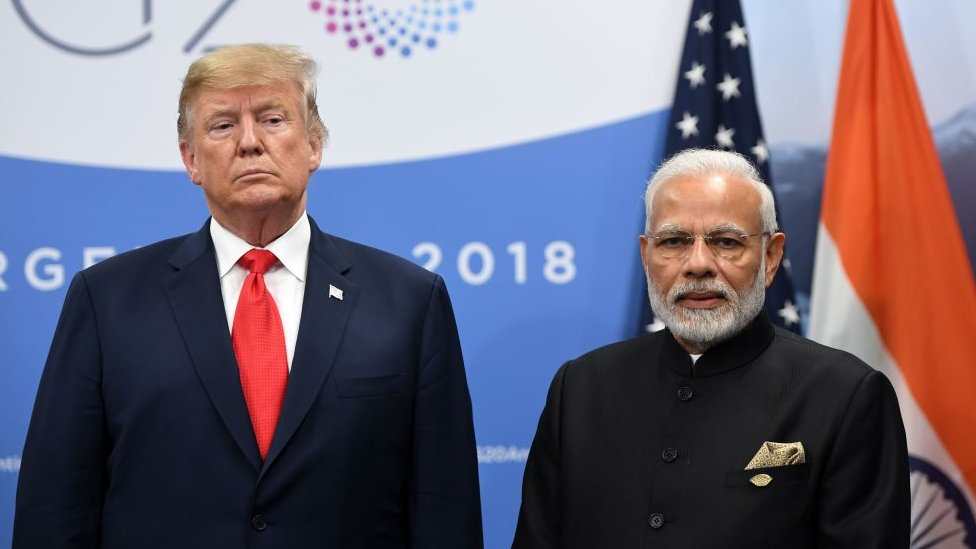
US President Donald Trump’s penchant for blunt, often provocative rhetoric was on full display once again when he publicly mocked Indian Prime Minister Narendra Modi while recalling a past meeting between the two leaders. Speaking at the House GOP Members’ Retreat on Wednesday, Trump struck a condescending note as he narrated how Modi had sought an audience with him, using the anecdote to underscore growing tensions between Washington and New Delhi over trade tariffs and India’s energy ties with Russia.
The remarks, delivered in Trump’s trademark off-the-cuff style, have sparked political ripples in India, with opposition parties accusing the Modi government of diplomatic weakness and silence in the face of repeated slights from a key strategic partner.
Trump’s Jibe and the Modi Anecdote
Addressing Republican lawmakers, Trump recalled an interaction with Modi that was meant to illustrate what he described as his leverage over world leaders through tariffs and trade pressure.
“Prime Minister Modi came to see me. [He said] ‘Sir, may I see you, please?’ Yes,” Trump told the audience, drawing laughter and applause from party members.
Trump went on to claim that Modi had waited five years after ordering 68 Apache attack helicopters from the United States, before eventually meeting him. While the remark appeared casual, critics noted that it portrayed the Indian Prime Minister as deferential, a framing that quickly became controversial back home.
“I have a very good relationship with him,” Trump continued, before adding pointedly, “He’s not that happy with me because, you know, they’re paying a lot of tariffs now, because they’re not doing the oil.”
The comment referred to India’s decision to halt or significantly reduce imports of Russian oil, a move that has placed New Delhi in the crosshairs of Washington’s aggressive trade policy under Trump’s renewed presidency.
Trump capped his remarks with a familiar boast. “The US is getting rich because of tariffs,” he said, reiterating a central theme of his economic worldview—that tariffs are not merely punitive tools but revenue-generating instruments that strengthen American bargaining power.
Tariffs at the Heart of the Dispute
At the core of the current tension lies Washington’s decision to impose sweeping tariffs on Indian goods. The US has slapped a cumulative tariff of up to 50 per cent on a wide range of Indian exports, among the highest duties imposed on any major economy.
A punitive 25 per cent tariff was first levied on India due to its continued purchases of Russian oil, which the Trump administration views as undermining Western efforts to economically isolate Moscow. This was added to an earlier 25 per cent tariff on several Indian products, taking the total duties to levels comparable with those imposed on China and Brazil.
Industries most affected include garments, gems and jewellery, footwear, sporting goods, furniture, and chemicals—sectors that employ millions in India and are heavily reliant on access to the US market.
The tariffs have already begun to bite, with exporters warning of shrinking margins, canceled orders, and potential job losses. Economists have cautioned that prolonged trade friction could dampen India’s growth outlook at a time when global economic conditions remain fragile.
Trump, however, has shown little inclination to soften his stance. Speaking to reporters during a press gaggle aboard Air Force One on Sunday, he suggested that the existing tariffs could be raised even further.
“They do trade, and we can raise tariffs on them very quickly,” Trump said when asked about India’s Russian oil purchases.
“Modi Is a Good Guy, But…”
In typical Trump fashion, criticism was paired with a backhanded compliment. “Modi is a good guy,” Trump said during the same interaction with reporters. “He knew I was not happy, and it was important to make me happy.”
The statement reinforced Trump’s self-image as a dealmaker who expects deference from allies and partners alike. For many observers, it also underscored the asymmetrical tone Trump often adopts in describing relationships with foreign leaders—particularly those from countries that depend on the US for trade, defense, or diplomatic support.
Political Storm in India
Trump’s remarks did not go unnoticed in India. The opposition Congress party was quick to seize on the comments, using them to attack Prime Minister Modi’s handling of foreign relations.
Taking to X (formerly Twitter), the Congress party shared a caricature depicting a timid Modi standing before a towering Trump, accompanied by excerpts from the US President’s speech. In a separate post in Hindi, the party claimed that Modi had gone to the US “uninvited” after Trump assumed office last January.
“You must remember—among the world’s leaders, Modi is the only one whom Trump did not come to receive at the gate,” the party wrote, attaching a video clip of Trump’s remarks.
The insinuation was clear: that Modi, who has often projected himself domestically as a strong, decisive global leader, was being publicly diminished by the US President.
Adding to the criticism, Rajya Sabha MP Priyanka Chaturvedi expressed sharp disapproval of Trump’s tone and the Indian government’s response—or lack thereof.
“His (Trump’s) condescending tone for India’s PM is demeaning,” Chaturvedi wrote on X. “The GoI’s silence to all his insulting statements is bizarre because it reflects poorly on our nation.”
Former Union minister Subramanian Swamy amplified Chaturvedi’s remarks by sharing her post, lending further weight to the growing chorus of criticism from across the political spectrum.
Government Silence and Strategic Calculus
Notably, the Indian government has so far refrained from issuing a formal response to Trump’s comments. This silence has been interpreted in different ways.
Supporters of the government argue that New Delhi is choosing restraint, aware that public sparring with Trump could further inflame trade tensions. They point out that diplomacy often requires absorbing rhetorical slights to protect larger strategic interests, including defense cooperation, technology transfers, and regional security partnerships.
Critics, however, see the silence as symptomatic of a deeper problem—a reluctance to stand up to Washington even when India’s leadership is publicly belittled. For them, Trump’s remarks strike at the heart of India’s global image and demand a firm rebuttal.
India–US Relations: Partners, Not Equals?
The episode has once again highlighted the complex, often contradictory nature of India–US relations. Over the past two decades, ties between the two countries have deepened significantly, spanning defense cooperation, intelligence sharing, technology, and people-to-people links.
India is a key partner in the Indo-Pacific strategy aimed at counterbalancing China’s rise. The two countries conduct regular military exercises, and the US remains one of India’s largest defense suppliers, with Apache helicopters—mentioned by Trump—among the most visible symbols of that partnership.
Yet, trade has long been a sore point. Even before Trump’s return to the White House, successive US administrations have complained about India’s tariffs, market access barriers, and regulatory environment. Trump’s approach, however, has been far more confrontational, using tariffs as a blunt instrument to force compliance.
The current standoff over Russian oil has added a geopolitical dimension to the trade dispute. India has consistently defended its energy purchases from Russia, arguing that they are driven by national interest and the need to ensure affordable energy for its population. New Delhi has also pointed out that several Western countries continue to buy Russian energy in indirect forms.
Washington, under Trump, has shown little patience for such arguments.
Optics and Domestic Politics
Trump’s remarks must also be viewed through the lens of domestic politics—both in the US and India.
In the US, Trump’s tough talk on tariffs plays well with his base, reinforcing his image as a leader who puts “America First” and extracts concessions from foreign governments. Mocking world leaders, particularly those from emerging economies, has long been part of his political persona.
In India, the optics are more complicated. Modi has built much of his domestic political brand around the idea of India as a confident, assertive global power. Public ridicule from the US President, especially when left unanswered, risks puncturing that narrative.
With elections never far from the political horizon, opposition parties are keen to frame Trump’s remarks as evidence of diplomatic failure—arguing that personal chemistry and high-profile summits have not translated into respect or tangible economic benefits.
What Lies Ahead?
The immediate future of India–US relations appears fraught. Trump has made it clear that tariffs will remain a central tool of his foreign policy and that India’s energy ties with Russia are a red line.
At the same time, neither side can afford a complete breakdown in relations. Strategic cooperation in the Indo-Pacific, shared concerns about China, and deep economic interdependence act as stabilizing forces.
Whether New Delhi chooses to respond publicly to Trump’s remarks or continue its strategy of quiet diplomacy remains to be seen. What is certain, however, is that Trump’s words have once again exposed the uneven dynamics of the relationship—one in which personal diplomacy, power politics, and public perception are tightly intertwined.
As tariffs rise and rhetoric sharpens, the challenge for both democracies will be to prevent short-term political posturing from undermining a partnership that has long been touted as one of the most consequential of the 21st century.