
Crypto staking is one of the most popular ways to earn rewards on coins you already own. But if you’ve got ETH or Bitcoin in your wallet, you might be torn between staking and holding long-term.
Our team at Crypto Roo has been writing about cryptocurrency investing strategies for years, and this question comes up constantly. So we built this guide to walk you through how crypto staking works, what kind of returns are realistic, and where the risks hide.
By the end, you’ll know which strategy fits your goals and your comfort level with risk.
How Does Crypto Staking Work?
Crypto staking is the process of locking your coins on a proof-of-stake blockchain network to help validate transactions. Think of it like a fixed-term deposit at your bank. Your crypto helps strengthen the blockchain’s security while it sits there.
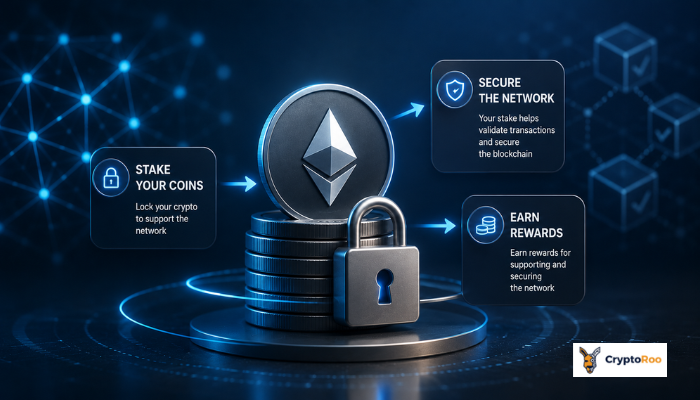
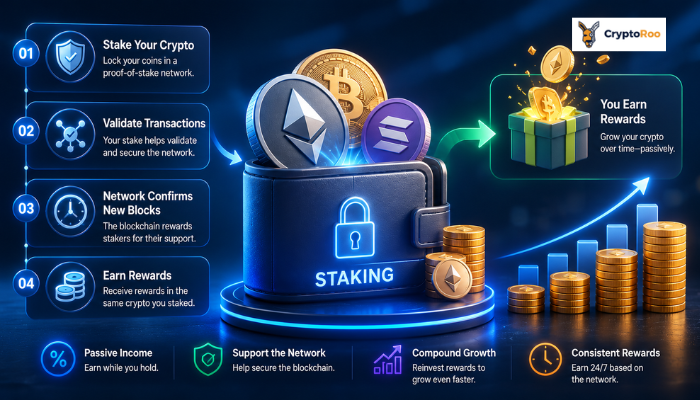
So how do you earn from this? Basically, every time the network confirms new blocks of transactions, validators who contributed their coins receive rewards. Other validators on the same network do the same, and the payouts get split based on how much each person staked.
The catch is the lock-up period. Some networks let you withdraw your ETH or other assets within days, while others hold your funds for four to eight weeks. During that time, you can’t sell or move your staked tokens.
Now, let’s look at how those rewards show up in your wallet.
How Do You Earn Rewards by Staking Crypto?
The best part about staking is that your coins earn rewards around the clock. You don’t need to trade or time the crypto market. Your staked assets do the work for you, and here’s what determines how much you’ll take home.
What Affects Your Staking APY?
Staking networks pay you in the same token you staked, similar to how a savings account pays dividends.
However, the rates vary quite a bit depending on the coin. Ethereum currently offers around 3% to 4%, while chains like Cosmos or Polkadot can pay between 7% and 15%. The number of validators on the network and token inflation both influence your final yield.
How Often Do You Get Paid?
Reward frequency depends on the blockchain you choose (Ethereum pays roughly every 6 minutes, while some chains make you wait days). Validator performance has a direct impact on your income too. If your chosen validator goes offline or misses new blocks, your earnings will drop.
Each of these factors affects your staking returns, so review the APY and payout schedule before you start earning rewards on any network.
Is Staking a Realistic Passive Crypto Income Strategy?
Look, staking can bring in steady passive crypto income, but don’t expect to quit your day job over it. Your earnings depend heavily on the crypto market, the coin you pick, and how long you’re willing to stay locked in.
What’s more, staking gets really interesting when you start compounding. If you reinvest your rewards instead of cashing out, your total stack grows without you spending another dollar. Over 12 months, that compounding effect can turn a modest stake into something more profitable than just sitting on your cryptocurrency.
Compared to holding alone, staking gives your assets a way to generate yield. Investors who skip staking earn nothing while they wait for prices to rise.
What’s more, your staking rewards count as taxable income the second you receive them under current IRS guidance on digital asset taxation. That applies even if the token’s value drops right after.
What Is Liquid Staking and How Does It Work?
Liquid staking lets you stake your crypto and receive a tradable token in return.
Your funds aren’t completely locked up like they are with traditional staking. Instead, you get a liquid token that represents your staked assets. And you can use it across DeFi protocols, lending platforms, or other yield opportunities (your coins keep earning even while you use the token somewhere else).
Below is a quick breakdown of how the two methods compare:
| Traditional Staking | Liquid Staking | |
| Access to Funds | Locked until the unstaking period ends | Tradable token available immediately |
| Reward Earning | Direct rewards from the network | Rewards plus additional DeFi yield |
| Flexibility | Limited, can’t withdraw or trade | Full liquidity and usage across platforms |
Platforms like Lido and Rocket Pool are the most popular liquid staking services for ETH users right now.
Both let you deposit your coins and start using them within minutes. You earn staking rewards and put your crypto to work across other platforms at the same time. That combination is the main reason liquid staking has grown so fast over the past two years.
Once you’ve decided to stake, the next step is picking the right platform for it.
How Do Centralized Exchanges Handle Staking?
Centralized exchanges like Coinbase and Kraken let you stake crypto directly from your account. You don’t need a separate wallet, and you won’t have to pick validators yourself. The exchange handles the entire process for you.
With that in mind, a few things are worth knowing before you start earning rewards through an exchange.
- Instant Account Access: You can fund your account with a deposit and begin staking within minutes. Most centralized exchanges support ETH, Solana, and other popular coins, so getting started won’t take long.
- No Technical Setup: The platform you choose runs its own validators and manages all the blockchain network operations for you. All you do is pick a token, choose how much to stake, and confirm the transaction.
- Fees Cut Into Your Rewards: Convenience comes at a cost. Exchanges take a percentage of your staking rewards as a monthly fee or service charge. Compared to running your own validator, you’ll earn less per dollar staked.
The trade-off is clear: You give up some yield and custody of your crypto in exchange for a simple, beginner-friendly staking experience.
But what if you want more control over your crypto and a higher yield? DeFi protocols offer exactly that.
Are DeFi Protocols Worth It for Your Digital Assets?
Some DeFi protocols offer staking APYs two or three times higher than what centralized exchanges pay. That extra yield sounds great, but it comes with risks you need to understand first.
The real upside here is custody. When you stake through a DeFi protocol, your digital assets stay in your own wallet. You aren’t relying on a third-party platform to hold your cryptocurrency for you. So, you get full control over your funds, your tokens, and your private keys at all times.
However, you’ll need to do your homework here because DeFi staking isn’t a one-click setup like what exchanges offer. You’re interacting directly with smart contracts on the blockchain, so that’s where the risk begins.
Smart contract risk has already cost the industry billions, and even well-known protocols have been hit. In 2024 alone, DeFi protocol exploits cost users $474 million, according to blockchain security firm Hacken (and beginners usually find out the hard way).
Is Crypto Staking High Risk?
Some stakers have lost coins just because their validator went offline for too long. That process is called slashing, and it happens frequently across proof-of-stake networks.
Keep these risks in mind before you lock up any of your cryptocurrency.
- Slashing Penalties Hit Hard: Validators who misbehave or go offline can get penalized by the blockchain network. When that happens, the network removes a portion of the staked crypto from everyone who delegated to it. You lose funds without doing anything wrong yourself.
- Locked During a Crash: If the crypto market drops while your coins are staked, you can’t sell to limit the damage. The highly volatile nature of cryptocurrency means prices can fall 20% or more in a single week. Being locked in during that kind of drop feels like watching your house flood while the front door is bolted shut.
- Rug Pulls and Liquidity Traps: Some smaller DeFi protocols promise high yield to attract deposits, then vanish overnight (and beginners usually find out the hard way). Even if the protocol doesn’t disappear, low liquidity can make it impossible to withdraw your assets when you need them.
Staking can be profitable, but it isn’t risk-free. Do your research, pick responsible platforms, and never invest more than you’re comfortable losing.
Staking Rewards or Long-Term Cryptocurrency Investing: Which Fits You?
We’ve spent time with both strategies, and there’s no single right answer. It depends on how patient you are and how you feel about locking up your coins.
If you want to earn rewards on crypto you already plan to hold, staking is the clear choice. You’ll generate passive income while your assets stay on the network. If you’d rather keep full access to your funds and avoid lockup periods, long-term investing without staking keeps things simple.
Crypto Roo has free guides and platform comparisons that can help you determine which approach works best. Take your time, do your due diligence, and pick the strategy that fits your financial goals.