
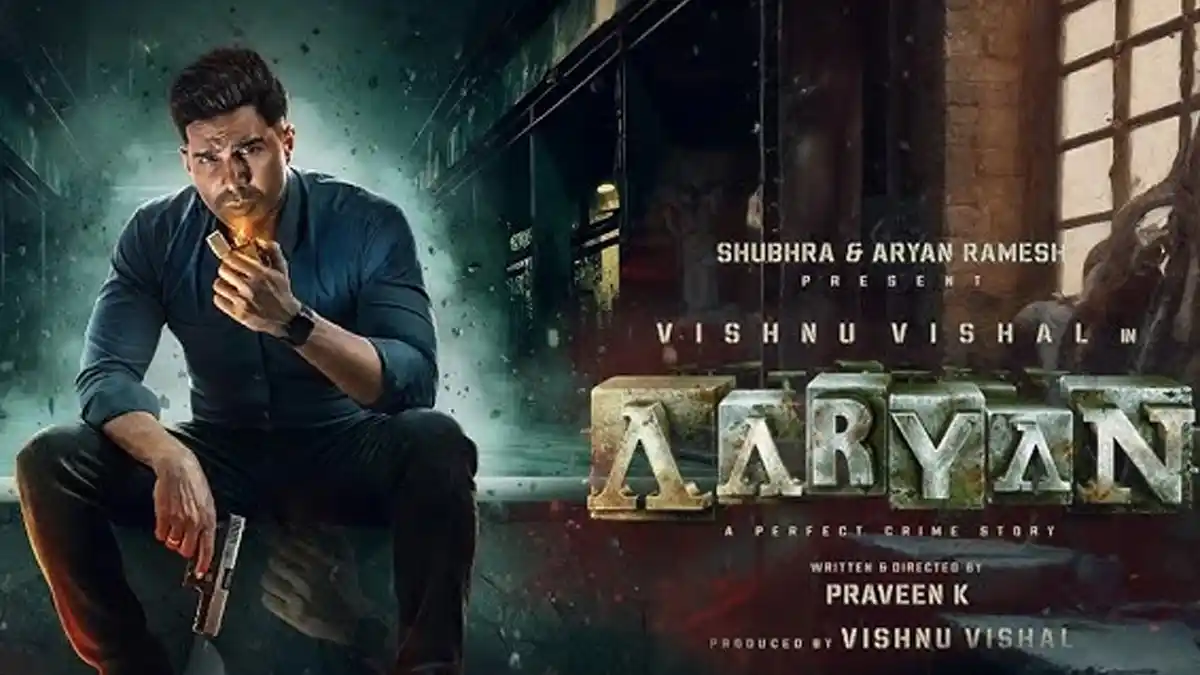
In an era where serial-killer thrillers have become increasingly formulaic, Aaryan arrives with an intriguing promise: what if the mystery is revealed upfront, and the film dares to ask questions that most genre entries avoid? Directed by Praveen K, and starring Vishnu Vishal, Shraddha Srinath, and Selvaraghavan, Aaryan attempts to subvert expectations even as it struggles under the weight of familiar cinematic compromises. The result is a film that is undeniably flawed, often overextended, yet consistently engaging — a work that begins with an ending and spends the rest of its runtime searching for meaning.
A Thriller That Breaks Its Own Rules
At just over two hours and fourteen minutes, Aaryan is a serial-killer thriller that actively resists the genre’s most reliable crutches. About 20 minutes into the film, Praveen K makes a daring narrative choice: the identity of the killer is revealed, and not in the climactic, pulse-pounding way audiences have been conditioned to expect. More radically, the film also hands down the harshest possible punishment to this killer almost immediately.
In doing so, Aaryan removes the traditional “whodunit” pleasure entirely. There is no slow drip of clues, no final revelation engineered to shock the audience. Instead, the film pivots to a far trickier question: why does someone become a serial killer, and what does justice even look like when redemption is impossible?
This structural gamble is both the film’s greatest strength and its most frustrating limitation. By stripping away suspense as we traditionally understand it, Aaryan forces viewers into morally ambiguous territory. We are no longer watching to see who will be caught, but how the system responds when catching the culprit changes nothing.
Justice Without Vengeance
Within the internal logic of Aaryan, justice becomes a deeply uncomfortable concept. The killer cannot be punished again. Closure is unavailable. And yet, the murders continue to ripple outward, leaving the police scrambling, families devastated, and society at large unsure of where accountability lies.
This decision destabilizes the audience’s emotional footing. With vengeance removed from the equation, the film places us in a liminal space where traditional loyalties feel misplaced. The chase itself begins to feel futile. Each time the investigation inches closer to a solution, the viewer feels an odd sense of defeat rather than triumph.
This is where Aaryan quietly achieves something rare: it makes us question who we are rooting for. Against our better judgment, we occasionally find ourselves aligning emotionally with the antagonist — not because we agree with his methods, but because the system pursuing him appears incapable of stopping the damage. It is an unsettling experience, and one that speaks to the film’s thematic ambition.
A Hero Who Keeps Losing
At the center of this moral maze is Nambi (Vishnu Vishal), the film’s protagonist and lead investigator. Nambi is competent, sincere, and committed — but he is also repeatedly ineffective. Of the five victims said to be next in line, the film moves grimly from one to another, with Nambi arriving just a step too late each time.
This repeated failure shapes our perception of him in unusual ways. In most serial-killer films, the hero’s persistence is rewarded, if not immediately then eventually. In Aaryan, persistence feels like a liability. The closer Nambi gets, the more inevitable the losses seem. Over time, this creates the impression of a hero who is simply not very good at his job — a provocative choice that the film only partially explores.
This dynamic works largely because Vishnu Vishal is willing to share narrative space with the antagonist. Many thrillers protect their heroes from being overshadowed, but Aaryan allows its protagonist to appear small, overwhelmed, and even redundant in the face of the villain’s ideological clarity.
The Ordinary Policeman Problem
Like many serial-killer films, Aaryan struggles with the challenge of making its hero as compelling as its villain. Nambi is written as a dutiful, straightforward officer — competent but emotionally muted. The film attempts to deepen him by introducing a subplot involving his impending divorce, rooted in his obsessive devotion to work.
One of the film’s more effective moments comes when a senior officer praises Nambi as an exceptional policeman and a tireless workaholic, as if the two traits are interchangeable. The very next scene reveals that this same workaholism has eroded his marriage. It’s a neat, efficient critique of institutional values — but it’s also one of the few moments where the film truly interrogates Nambi’s inner life.
Beyond this, the character remains frustratingly opaque. The romantic flashback involving Shraddha Srinath adds little to the narrative momentum, offering neither emotional catharsis nor fresh insight. By the end of the film, we know little more about Nambi than we did at the beginning — a significant missed opportunity in a story so invested in psychological inquiry.
A Villain Who Deserved More Space
If Aaryan has a magnetic center, it is Azhagan, played with controlled menace by Selvaraghavan. As the antagonist, Azhagan is fascinating not because of what he does, but because of what he represents. He is not portrayed as a chaotic force of evil, but as a man operating within a warped yet internally consistent moral framework.
Unfortunately, the film underutilizes him. For a story that hinges on understanding the “why” behind violence, Aaryan spends surprisingly little time inhabiting Azhagan’s psyche. When the film finally attempts to explain him, it does so through a lengthy, expository monologue reminiscent of a Shankar-style villain speech — loud, theatrical, and ultimately reductive.
What the film needed instead was restraint. Azhagan’s philosophy would have been far more powerful if revealed through behavior, silence, and contradiction, rather than explicit explanation. A little more of Selvaraghavan, deployed with subtlety, could have elevated Azhagan into the pantheon of truly unforgettable Tamil cinema antagonists.
Subplots That Dilute the Core
One of Aaryan’s most persistent problems is its unwillingness to fully commit to its strongest ideas. An unconvincing subplot involving a group of gangsters tenuously linked to the main narrative feels like a concession to commercial expectations. Its primary function appears to be the insertion of action sequences — competently staged but emotionally hollow.
These detours sap energy from the film’s philosophical core and inflate its runtime unnecessarily. In a film already grappling with pacing issues, such compromises feel especially costly. The irony is unavoidable: Aaryan has so much to say, yet spends too much time saying things that don’t matter.
Long, Flabby… But Still Engaging
Despite its structural excesses and narrative compromises, Aaryan remains watchable — often compellingly so. This is largely due to the strength of its central premise and the sincerity of its execution. Praveen K may not fully escape the gravitational pull of genre conventions, but he consistently pushes against them.
The film makes you feel uneasy in productive ways. It asks uncomfortable questions about justice, heroism, and the limits of institutional power. Even when it falters, it does so while reaching for something more ambitious than the average serial-killer thriller.
The Bottom Line
Aaryan is a film that feels both fresh and familiar, innovative and constrained. It introduces a bold narrative setup that deserved a tighter, more disciplined execution. Its hero is deliberately underwhelming, its villain tantalizingly underwritten, and its subplots often unnecessary. And yet, for all its flaws, it holds your attention until the very end.
Perhaps that is its greatest achievement. Even when it feels like it has already told us its ending, Aaryan gives us enough to chew on — ethically, emotionally, intellectually — to make the journey worthwhile.
Verdict:
A long, flabby, but engaging serial-killer thriller that dares to begin where most films end — and, despite stumbling along the way, earns its place as a thought-provoking addition to Tamil cinema.