
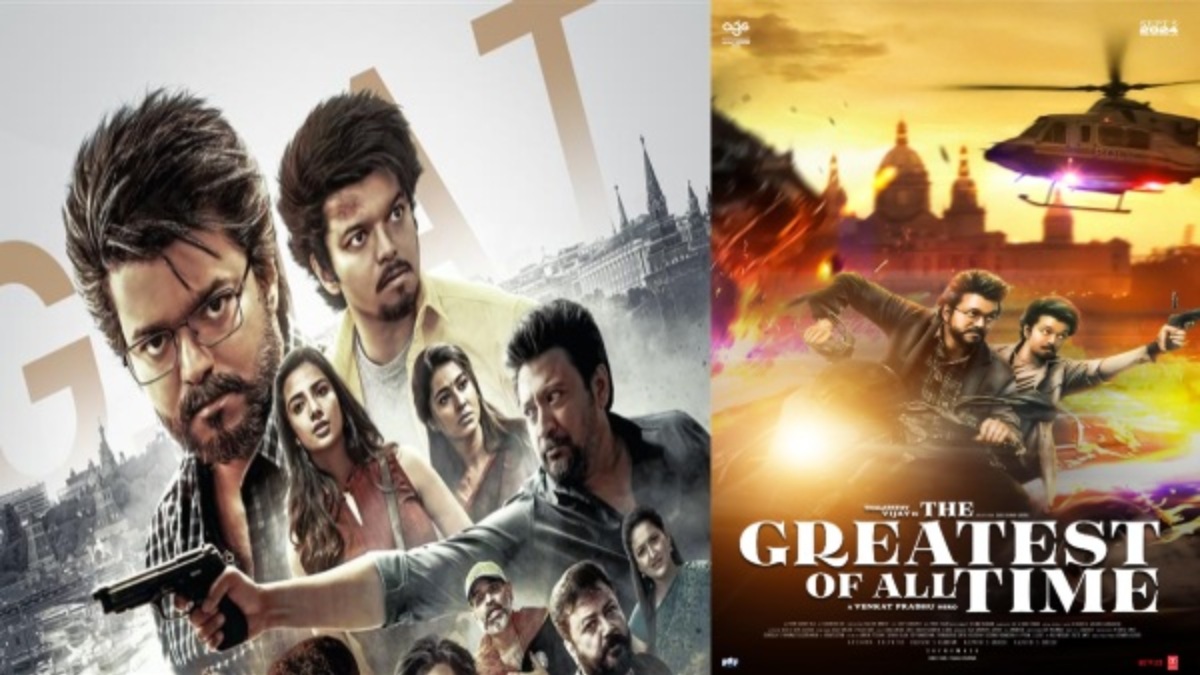
In the constantly evolving landscape of Tamil cinema, very few films arrive carrying the weight of expectation, spectacle, and cultural significance quite like Tamil Dhool GOAT – The Greatest of All Time. Released worldwide on 5 September 2024, GOAT is more than just another high-octane action thriller—it is a landmark film that stands at the crossroads of cinema, stardom, and legacy. Directed by Venkat Prabhu and headlined by Vijay in dual roles, the film marks the superstar’s penultimate cinematic appearance before his much-anticipated entry into politics.
With a massive budget, globe-trotting locations, cutting-edge action, and an emotionally charged narrative rooted in family, betrayal, and identity, GOAT attempts something ambitious: to merge mass entertainment with a complex, layered story about consequences that refuse to stay buried. While critical response was mixed, the film’s box office performance and cultural impact cement its place as one of the most discussed Tamil films of 2024.
A Title That Carries a Statement
Marketed boldly as The Greatest of All Time, or simply GOAT, the title is a deliberate provocation. In sports, music, and cinema, “GOAT” is a label reserved for legends. In Tamil cinema, the acronym instantly invites comparison, debate, and fan-driven celebration. The branding also aligns seamlessly with Vijay’s stature—an actor whose career spans decades, generations of audiences, and an almost unmatched fan following.
For platforms and fan communities like Tamil Dhool, the phrase “Tamil Dhool GOAT – The Greatest of All Time” quickly became shorthand for a film positioned as an event rather than a routine release. It promised scale, emotion, and a definitive statement on Vijay’s screen persona.
From Thalapathy 68 to GOAT: The Making of a Mega Project
Officially announced in May 2023 under the working title Thalapathy 68, the film generated buzz from the moment AGS Entertainment confirmed its collaboration with Vijay. By December 2023, the official title The Greatest of All Time was unveiled, signaling the studio’s confidence and ambition.
Directed by Venkat Prabhu, known for his sharp screenplays and ensemble storytelling, GOAT marked a tonal shift from his lighter, more playful films. This time, the director embraced a darker, more intense action-thriller format while still retaining his flair for twists and reveals.
Principal photography began in October 2023 and wrapped by June 2024, spanning an impressive list of international and domestic locations: Chennai, Thailand, Hyderabad, Sri Lanka, Pondicherry, Thiruvananthapuram, Russia, and the United States. The global scale of the shoot mirrors the film’s international espionage narrative and reinforces its big-budget identity.
A Cast That Blends Nostalgia and Star Power
One of GOAT’s major strengths lies in its ensemble cast. Alongside Vijay in dual roles, the film features a mix of seasoned performers and familiar faces:
- Prashanth
- Prabhu Deva
- Mohan
- Jayaram
- Ajmal Ameer
- Vaibhav
- Yogi Babu
- Premgi Amaren
- Sneha
- Laila
- Meenakshi Chaudhary
- Abyukta Manikandan
This multi-generational casting adds texture to the narrative, particularly in scenes involving the Special Anti-Terrorism Squad (SATS). Venkat Prabhu’s comfort with handling ensembles is evident, even if some characters could have benefited from deeper development.
The Story: Espionage, Loss, and the Weight of the Past
At its core, GOAT is a story about how past actions echo across time, often with devastating consequences.
The 2008 Mission
The film opens in 2008 with the Special Anti-Terrorism Squad—led by M. S. Gandhi—on a mission in Kenya to intercept terrorist Omar and recover uranium. Alongside Gandhi are his trusted teammates Sunil, Kalyan, and Ajay. Their former chief, Rajiv Menon, disgraced and charged with treason, unexpectedly resurfaces.
Believing Menon and everyone aboard a sabotaged train to be dead, the team completes the mission and returns to India, assuming the chapter is closed. It is not.
Family Undercover
Back in Delhi, the SATS members live undercover as employees of a tourism agency, hiding their true identities even from their families. Gandhi’s personal life is portrayed with warmth and vulnerability—he lives with his pregnant wife Anuradha (Anu) and their young son, Jeevan.
When Gandhi is sent on a mission to Bangkok, he brings his family along to allay Anu’s suspicions. What follows is one of the film’s most emotionally devastating sequences: an attack that results in Jeevan’s disappearance and the discovery of a charred body believed to be his. The loss fractures Gandhi’s family, leaving Anu emotionally shattered and silent.
A 16-Year Jump and a Shocking Revelation
By 2024, Gandhi has left active service and works as an immigration officer at Chennai International Airport. His life is subdued, defined by guilt, separation, and routine. His daughter Jeevitha lives with Anu, and the family remains emotionally broken.
The narrative reignites when Gandhi is called to Moscow to train officers at the reopened Indian Embassy. An attack there leads to the film’s most startling revelation: one of the attackers is a young man who looks exactly like Gandhi—and is revealed to be Jeevan, alive.
This reunion is brief and deceptive. While the family begins to heal, a masked assassin murders Nazeer, Gandhi’s former superior. The killer is revealed to be Jeevan himself, plunging the story into darker psychological territory.
Dual Roles, Dual Conflicts
Vijay’s performance is central to GOAT’s impact. As Gandhi, he embodies restraint, pain, and moral conflict. As Jeevan (and later, Sanjay), he portrays rage, manipulation, and fractured identity. The dual role is not merely a technical showcase but a thematic device—father and son, protector and destroyer, hero and antagonist.
The film reveals that Rajiv Menon survived the 2008 incident but lost his own family. In a cruel cycle of vengeance, he kidnapped Jeevan, raised him under a false identity, and twisted his perception of Gandhi into that of a villain. Jeevan’s transformation into Sanjay is one of the film’s most disturbing elements, illustrating how trauma and manipulation can weaponize identity.
Twists, Betrayals, and Moral Ambiguity
True to Venkat Prabhu’s style, GOAT is layered with betrayals and sudden reversals. Allies become enemies, loyalties fracture, and moral certainty erodes.
Kalyan’s betrayal, Sunil’s personal tragedy involving his daughter Srinidhi, and the murky ethics of “necessary evils” within intelligence operations all add complexity to the narrative. These elements elevate GOAT beyond a straightforward action film, even if the screenplay occasionally struggles to balance its many threads.
A High-Stakes Climax
The final act unfolds at the M. A. Chidambaram Stadium, where Jeevan plans a large-scale bombing designed not only to kill thousands but to frame Gandhi for treason. The stadium setting amplifies the tension, symbolizing public spectacle versus hidden truth.
With help from family members and former allies, Gandhi thwarts the plan. The emotional peak arrives when Jeevan threatens Gandhi’s daughter, forcing Gandhi into an impossible choice. The act of killing his own son—manipulated, cloned, and consumed by vengeance—is portrayed not as triumph, but tragedy.
The final twist reveals that the Jeevan killed was a clone, and the real Sanjay continues to create more clones, leaving the story open-ended and haunting.
Music, Technical Craft, and Visual Scale
Yuvan Shankar Raja’s music underscores the film’s emotional and action beats effectively, with a background score that leans heavily into tension rather than melody. Cinematographer Siddhartha Nuni delivers polished visuals, especially in international sequences and action set pieces.
Editing by Venkat Raajen keeps the narrative moving, though some critics noted that tighter pacing and deeper character exploration could have strengthened the film.
Box Office and Reception
Despite mixed critical reviews—praising Vijay’s performance, action choreography, and climax while critiquing the writing and character depth—GOAT emerged as a commercial success. With worldwide earnings estimated between ₹440–460 crore against a budget of ₹380–400 crore, it became:
- The highest-grossing Tamil film of 2024
- The fourth highest-grossing Indian film of 2024
- One of the most expensive non-English films ever made
The numbers reflect Vijay’s enduring box office pull and the film’s appeal as an event movie.
Legacy: More Than Just a Film
Tamil Dhool GOAT – The Greatest of All Time will be remembered not only for its story or spectacle, but for its timing. As Vijay prepares to transition into politics, GOAT feels like a reflective farewell to his action-hero persona—one that questions power, responsibility, and the cost of decisions made in the shadows.
It is not a perfect film, but it is an ambitious one. And in its ambition, scale, and emotional weight, GOAT stands as a defining chapter in Vijay’s cinematic journey—an exploration of legacy, both personal and political, wrapped in the explosive grammar of Tamil mass cinema.