
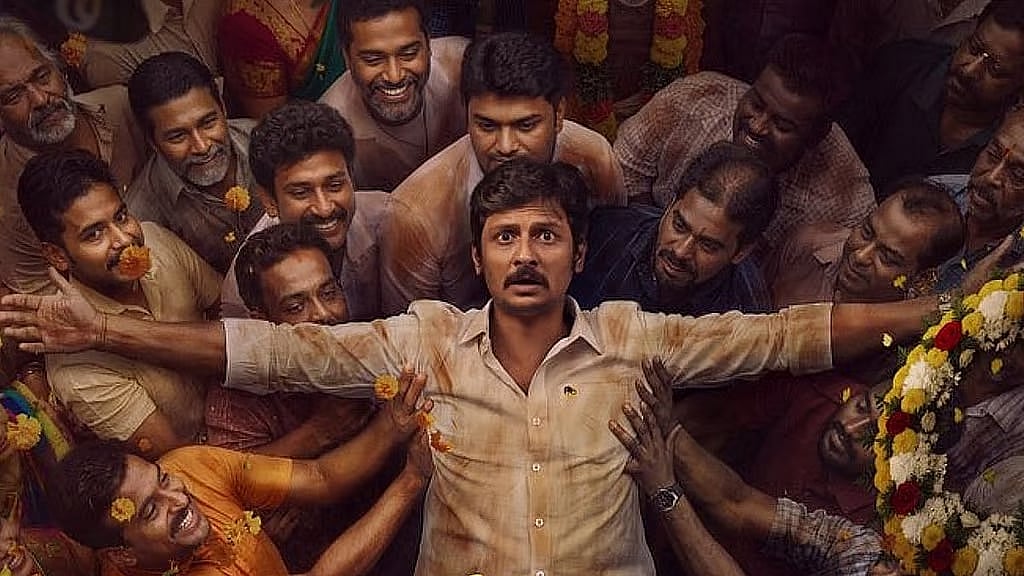
Cinema has long served as a lens through which societies examine themselves, often revealing the intricate dynamics of power, tradition, and human nature. In this tradition, “Tamil Dhool Halaivar Thambi Thalaimaiyil” emerges as a significant addition to contemporary Tamil cinema. Directed by Nithish Sahadev and co-written by him alongside Sanjo Joseph and Anuraj O. B, the film debuted theatrically on 15 January 2026 and has already garnered widespread acclaim from critics for its sharp satire, layered performances, and insightful commentary on village politics.
Featuring Jiiva in the lead role, supported by Prathana Nathan and Thambi Ramaiah, the film centers on a village council president caught in the crossfire of social and familial chaos after an unexpected death coincides with wedding festivities. Through humor, suspense, and keen observation of human behavior, Halaivar Thambi Thalaimaiyil explores the delicate balance between leadership, tradition, and the unpredictability of rural life.
Plot Overview: When Life and Death Collide
The narrative of Halaivar Thambi Thalaimaiyil revolves around Jeevarathnam (Jiiva), the respected president of a village panchayat, whose responsibilities unexpectedly expand into managing not just community disputes but life-and-death situations. The story opens on the eve of a highly anticipated wedding at the home of Ilavarasu, Sowmya’s father, where Jeevarathnam’s role is to ensure that the celebrations proceed smoothly.
Everything seems ordinary until a death occurs at the neighboring house of Mani (Thambi Ramaiah). This tragic event sets off a ripple of conflicts as both families demand that their respective rituals—the wedding and the funeral—take place simultaneously, neither willing to yield. The situation escalates into a high-stakes standoff, forcing Jeevarathnam to mediate, negotiate, and ultimately impose order amidst a chaotic swirl of grief, joy, and societal expectation.
What sets the film apart from standard rural comedies or dramas is its intricate layering of political and social satire. The narrative examines not just the personal tensions of the families involved but also the mechanics of local governance, the influence of public opinion, and the subtle interplay between authority and community compliance. Jeevarathnam’s role as the panchayat president becomes a metaphor for leadership under pressure—a study in patience, diplomacy, and ethical judgment.
Performances: Jiiva Anchors the Chaos
At the heart of Halaivar Thambi Thalaimaiyil is Jiiva, whose portrayal of Jeevarathnam is both nuanced and compelling. Jiiva imbues his character with an accessible humanity, blending authority with vulnerability, humor with gravitas. Jeevarathnam is not portrayed as a flawless leader; rather, he is a man navigating impossible circumstances, whose intelligence, patience, and moral compass are constantly tested. Jiiva’s performance is characterized by subtle expressions, a keen sense of timing in comedic moments, and a grounded approach to the film’s dramatic sequences.
Thambi Ramaiah, as Mani, provides both comic relief and emotional depth. His portrayal of a grieving man caught between tradition and family expectations offers a counterpoint to Jeevarathnam’s composed pragmatism. Meanwhile, Prathana Nathan as Sowmya delivers a restrained yet poignant performance, highlighting the ways in which ordinary villagers negotiate love, duty, and societal pressure in the midst of extraordinary circumstances.
The ensemble cast, including Ilavarasu, Jenson Dhivakar, Sarjin Kumar, and Rajesh Pandian, contributes significantly to the film’s texture. Each supporting actor adds authenticity to the village setting, whether as family elders asserting authority, relatives navigating grief, or friends caught in the absurdities of simultaneous life events. The chemistry among the cast ensures that the narrative feels alive and immersive, with each scene reflecting the complex tapestry of rural society.
Direction and Screenplay: Satire Meets Reality
Nithish Sahadev’s directorial approach in Halaivar Thambi Thalaimaiyil is marked by a deft balance of humor, suspense, and social commentary. The screenplay, co-written by Sahadev, Sanjo Joseph, and Anuraj O. B, excels in creating a world that feels simultaneously realistic and exaggerated, reflecting the heightened stakes inherent in village politics.
The film’s strength lies in its attention to detail. From the careful depiction of ritual practices to the subtle power dynamics among villagers, the narrative captures the rhythms of rural life with authenticity. The script also leverages humor as a tool for critique: witty dialogues, situational comedy, and the absurdity of overlapping family demands highlight societal tensions while entertaining audiences.
Sahadev’s direction ensures that the film never feels preachy. Instead, the political satire emerges organically through the characters’ interactions and decisions. The narrative structure builds tension steadily, culminating in a climax that is both emotionally satisfying and thematically resonant.
Cinematic Craft: Visual Storytelling
Cinematography in Halaivar Thambi Thalaimaiyil plays a crucial role in immersing audiences in the village setting. The camera work balances intimate close-ups, capturing subtle emotional shifts, with wider shots that situate characters within the social and cultural landscape. The visual framing emphasizes both the claustrophobia of conflicting events and the expansiveness of rural life, creating a dynamic interplay between personal and communal stakes.
Editing is precise, allowing comedic timing to land effectively while maintaining tension during dramatic sequences. The pacing ensures that audiences remain engaged, with the film transitioning smoothly between moments of levity and gravity. Production design, costume choices, and set construction contribute to a vivid representation of village life, lending authenticity to the narrative while highlighting cultural specificity.
Themes: Leadership, Community, and Human Nature
At its thematic core, Halaivar Thambi Thalaimaiyil is an exploration of leadership under duress. Jeevarathnam’s role as panchayat president embodies the challenges of governance at a microcosmic level: balancing competing interests, negotiating conflicting traditions, and making ethically complex decisions in real time.
The film also delves into the social rituals of life and death, contrasting the joy of a wedding with the solemnity of a funeral. By forcing these events to coexist, the narrative examines societal rigidity, human stubbornness, and the ways in which cultural norms both guide and constrain individual behavior.
Underlying the humor and satire is a meditation on human nature itself: pride, compromise, empathy, and moral courage all emerge as central motifs. The film demonstrates that leadership is not about authoritarian control but about understanding, patience, and the capacity to mediate conflicts without sacrificing humanity.
Political Satire in Contemporary Tamil Cinema
Halaivar Thambi Thalaimaiyil situates itself firmly within the tradition of Tamil political satire, a genre that has historically blended humor with incisive social commentary. By setting the story within a village panchayat, the film critiques the bureaucratic and social intricacies of rural governance while highlighting universal human dilemmas.
Unlike overtly political films that may lean toward caricature or polemic, Sahadev’s approach is subtle, allowing audiences to engage with the satire through relatable characters and believable scenarios. The overlapping wedding and funeral serve as a metaphor for the absurdities of leadership and the delicate negotiation required to balance competing priorities.
Music and Soundscape
While the narrative and performances are central, the film’s sound design and music enhance its impact. Traditional instruments and ambient soundscapes reinforce the rural setting, while musical cues highlight emotional peaks and comedic beats. The soundtrack complements the pacing of the film, guiding viewers through tension, humor, and reflection.
Reception and Critical Acclaim
Since its release, Halaivar Thambi Thalaimaiyil has been met with positive reviews from critics, who have lauded Jiiva’s performance, Sahadev’s direction, and the screenplay’s balance of humor and social insight. Audiences have particularly appreciated the film’s ability to entertain while offering thoughtful commentary on leadership, community, and cultural practices.
Critics have also highlighted the film’s universal appeal. Although deeply rooted in Tamil village life, its themes of governance, human conflict, and moral decision-making resonate broadly, allowing audiences outside South India to connect with its story.
Conclusion: A Comedy of Chaos and Reflection
“Tamil Dhool Halaivar Thambi Thalaimaiyil” is a rare blend of humor, political insight, and human drama. Through the lens of a village council president navigating an impossible situation, the film explores the challenges of leadership, the intricacies of community life, and the enduring tension between tradition and modernity.
Jiiva anchors the narrative with a performance that is at once relatable and commanding, while the ensemble cast enhances the story’s richness and authenticity. Nithish Sahadev’s direction ensures a seamless balance between comedy, suspense, and social commentary, creating a film that is both entertaining and intellectually engaging.
With its clever satire, grounded performances, and cinematic finesse, Halaivar Thambi Thalaimaiyil exemplifies the potential of contemporary Tamil cinema to blend humor, drama, and social reflection. It is a film that resonates on multiple levels, offering laughter, insight, and contemplation in equal measure. For viewers seeking a story about leadership, community, and human resilience amidst chaos, this film stands out as a must-watch in 2026.