
The Tamil film industry has often returned to prison dramas to interrogate power, prejudice, and justice. From hard-hitting classics to more sentimental narratives, the genre has proven flexible enough to reflect changing social realities. Sirai, released on 24 December 2025, arrives with the promise of seriousness rather than spectacle. Marketed as an action, drama, and thriller, the film instead chooses restraint, realism, and moral inquiry over overt dramatics. This Tamil Dhool Sirai Tamil movie review examines how the film succeeds as a grounded procedural drama while occasionally stumbling under the weight of emotional manipulation.
Directed by Suresh Rajakumari, Sirai unfolds across two timelines between 1997 and 2002, centering on a seemingly simple task: escorting a prisoner from Vellore jail to Sivagangai court. Yet within this narrow narrative frame, the film attempts to expose systemic failures, institutional apathy, and deeply ingrained social prejudices. Anchored by Vikram Prabhu’s controlled and quietly powerful performance, Sirai largely succeeds in making its audience reflect on the machinery of justice—even if it sometimes forces emotion where nuance might have worked better.
A Simple Journey, a Complex System
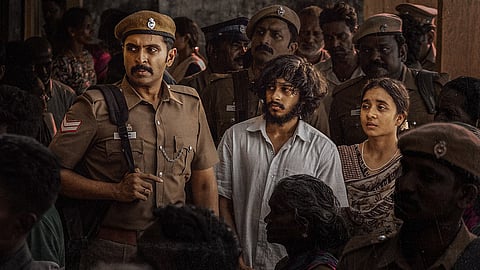
At its core, Sirai is about movement—physical, moral, and emotional. Constable Kathiravan (Vikram Prabhu) is assigned to escort Abdul (LK Akshay Kumar), a Muslim prisoner accused of murder, from Vellore jail to Sivagangai court. What should be a routine transfer becomes a window into how the criminal justice system treats those at its margins.
The film’s brilliance lies in how it portrays routine. There are no dramatic chase sequences or stylized confrontations during the escort. Instead, we see overcrowded court corridors, overworked policemen, and prisoners reduced to case numbers. Hearings feel less like opportunities for justice and more like bureaucratic checkpoints, where outcomes seem pre-decided long before anyone steps into the courtroom.
This procedural realism gives Sirai a documentary-like texture. The film does not shout its politics; it allows the everyday functioning of the system to speak for itself. In doing so, it aligns itself with a quieter tradition of Tamil cinema that trusts its audience to read between the lines.
Vikram Prabhu’s Strength Lies in Restraint
One of the strongest aspects of Sirai—and a key reason this Tamil Dhool Sirai Tamil movie review leans positive—is Vikram Prabhu’s performance. As Kathiravan, he avoids heroism in the conventional sense. There are no grand monologues or dramatic transformations. Instead, his performance is built on small gestures, pauses, and internal conflict.
Kathiravan is not portrayed as a flawless crusader for justice. He carries his own biases, shaped by the institution he serves. However, he operates on a simple but dangerous philosophy: speak up or get run over. In a system that rewards silence and obedience, this belief alone makes him quietly radical.
At pivotal moments, Kathiravan’s refusal to look away inspires others—junior officers, indifferent superiors—to reconsider their actions. These moments are not played for applause; they are understated and believable. Vikram Prabhu conveys moral courage not as bravado, but as a burden that comes with consequences.
Abdul: A Victim of System and Storytelling
While Kathiravan’s arc feels organic, Abdul’s character struggles under the weight of familiarity. Played with sincerity by LK Akshay Kumar, Abdul is positioned as a victim of both communal prejudice and narrative convenience.
Through flashbacks, the film reveals Abdul’s past: a Muslim family living in a predominantly Hindu village, tensions simmering beneath the surface, and an eventual eruption of violence. These elements are not inherently flawed, but their execution feels overly familiar. Tamil cinema has explored similar ground many times before, and Sirai does little to subvert expectations here.
Abdul’s romantic subplot further exposes the film’s weaknesses. His lover belongs to a household dominated by an abusive, alcoholic brother-in-law—a character that feels more like a plot device than a fully realized antagonist. The conflicts unfold with predictable timing, relying on coincidences that strain credibility. A crucial moment—where Abdul’s girlfriend is caught receiving money and jewels meant to help the couple elope—feels engineered to push the story toward tragedy rather than emerging naturally from character choices.
As a result, Abdul remains somewhat flat despite Akshay Kumar’s earnest performance. We are told to empathize with him, but the film rarely allows him the complexity that would make that empathy truly earned.
Emotional Weight vs. Emotional Manipulation
One of the most debated aspects of Sirai is its emotional approach. The film clearly wants to move its audience, and often it succeeds. Certain scenes—particularly those depicting institutional indifference—hit hard precisely because they are understated.
However, the flashback portions lean heavily into emotional manipulation. Background scores swell at predictable moments, conflicts escalate too neatly, and tragedy arrives on cue. The film sometimes sacrifices character depth for emotional impact, prioritizing how the audience should feel over why these characters behave as they do.
This imbalance is noticeable because the present-day narrative is so well-handled. The escort journey, with its quiet tension and moral ambiguity, proves that Sirai is capable of subtle storytelling. When the flashbacks shift into melodrama, the contrast becomes jarring.
A Thoughtful Look at Institutional Prejudice
Despite its flaws, Sirai deserves credit for its honest portrayal of systemic prejudice. The film does not reduce discrimination to a single villain or event. Instead, it shows how bias is embedded in everyday practices: casual remarks, unchecked assumptions, and procedural shortcuts.
The police force is depicted neither as wholly corrupt nor as noble saviors. Officers carry personal prejudices into their work, often unconsciously. Courtrooms are overcrowded and indifferent, prioritizing efficiency over fairness. Prisoners are stripped of individuality long before verdicts are delivered.
By situating its story between 1997 and 2002, Sirai subtly reminds viewers that these issues are not relics of the past. The period setting allows the film to reflect on how little—and how much—has changed.
Direction and Craft: Honest but Uneven
Director Suresh Rajakumari shows commendable restraint in handling the procedural elements of Sirai. The camera often lingers, allowing scenes to breathe. There is a deliberate avoidance of sensationalism in the present-day narrative, which strengthens the film’s credibility.
However, the unevenness between timelines suggests a lack of confidence in subtlety when dealing with emotional backstories. Where the escort journey trusts silence and observation, the flashbacks rely on familiar tropes and dramatic shortcuts.
Technically, the film is solid. The cinematography captures the oppressive monotony of institutional spaces—jails, police vans, court complexes—without resorting to stylization. The background score, while effective in parts, occasionally overreaches, signaling emotions that the performances have already conveyed.
Why Sirai Still Matters
Even with its missteps, Sirai stands out in contemporary Tamil cinema for its seriousness of intent. In an industry often dominated by spectacle-driven narratives, the film’s focus on procedural realism feels refreshing.
This Tamil Dhool Sirai Tamil movie review would be incomplete without acknowledging how rare it is for mainstream films to depict the criminal justice system without glorification. Sirai does not offer easy solutions or cathartic resolutions. Justice, when it appears, feels partial and fragile.
Vikram Prabhu’s performance ensures that the film remains compelling even when the writing falters. His Kathiravan embodies a quiet resistance that feels authentic and relatable. It is this grounded humanity that ultimately carries Sirai through its weaker stretches.
Final Verdict
Sirai is not a perfect film, but it is an important one. It succeeds most when it trusts realism over melodrama and performance over manipulation. Its portrayal of systemic failure, everyday prejudice, and moral courage resonates long after the credits roll.
While the flashback portions rely too heavily on familiar tropes and emotional shortcuts, these flaws do not entirely undermine the film’s impact. The procedural honesty, anchored by Vikram Prabhu’s understated performance, outweighs the missteps.
For viewers seeking a thoughtful, grounded drama that engages with social realities rather than escaping them, Sirai is worth watching. It may tug too hard at heartstrings at times, but beneath that emotional insistence lies a sincere attempt to ask uncomfortable questions about justice, responsibility, and the cost of speaking up.
Rating: 3.5/5
In the landscape of Tamil prison dramas, Sirai earns its place not by shouting the loudest, but by speaking softly—and, more often than not, truthfully.