
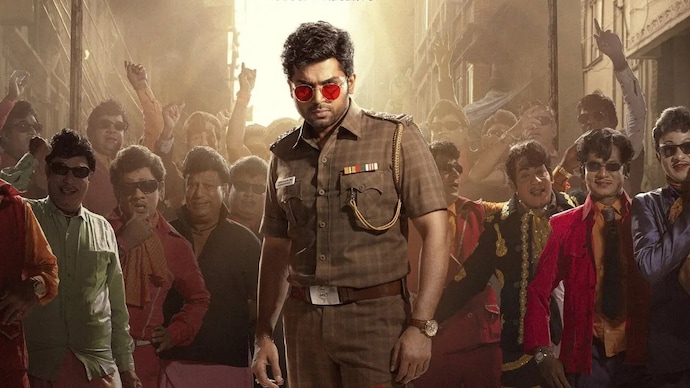
When Vaa Vaathiyaar hit theaters on 14 January 2026, coinciding with Pongal — one of Tamil cinema’s most commercially significant festivals — expectations were sky‑high. Not because it was just another star vehicle, but because it arrived after years of anticipation, delays, and an unusually lengthy production that spanned nearly two years. At its heart, this Indian Tamil‑language action‑comedy is also a character‑driven exploration of legacy, identity, corruption, and redemption — a rich blend of masala crowd‑pleasing with thoughtful introspection.
Directed and written by Nalan Kumarasamy, a filmmaker celebrated for his ability to mix sharp satire with emotional depth, Vaa Vaathiyaar stands as one of the most talked‑about Tamil films of the year. Produced by K. E. Gnanavel Raja under the banner of Studio Green, it marks the 26th leading role for acclaimed actor Karthi — a milestone long whispered in industry circles under the tentative title Karthi 26 before its official announcement in May 2024.
What emerges on screen is a film that is at once entertaining, reflective, and culturally resonant — a movie that looks at personal ambition and public morality through the lens of one man’s struggle to reconcile his identity with the weight of myth.
A Story of Legacy, Expectation, and Self‑Discovery
At its core, Vaa Vaathiyaar is the story of Ramasamy “Ramu” Rameshwaran, an earnest but conflicted man raised under an extraordinary shadow: that of M. G. Ramachandran (MGR), the legendary Tamil actor‑politician beloved as “Vaathiyaar,” a figure synonymous with justice, compassion, and service to the common people.
Ramu’s grandfather — the indomitable Rajkiran — believes that his grandson is the spiritual reincarnation of MGR because he was born on the very day the icon passed away. From his earliest days, Ramu is immersed in MGR’s ideals: fairness, discipline, humility, and relentless public service. This upbringing — half myth, half devotion — becomes both a blessing and a burden.
The central arc of Vaa Vaathiyaar follows Ramu’s tumultuous journey from a proud believer in those principles to a deeply flawed figure who must confront his own compromises, corruption, and moral failures. His life becomes a powerful mirror for the audience, echoing the larger tension in Indian society between idealism and the messy reality of political and institutional decay.
Plot Overview: From Idealism to Compromise and Back Again
Ramu begins his career as a police officer — not out of ambition, but out of a sense of duty instilled in him since birth. Initially, he strives to embody MGR’s values, confronting corruption and fighting for the marginalized. But as time passes, the world he once believed in reveals itself to be riddled with systemic rot, political manipulation, and influential figures whose moral compasses are disturbingly misaligned.
Exposure to this corrupt ecosystem begins to wear on Ramu. Bit by bit, he strays from the ideals he was raised to uphold. In a narrative twist that defines the heart of the film, Ramu compromises his principles, forming alliances with morally questionable powerbrokers and gradually indulging in the very practices he once despised. This descent is not portrayed as black‑and‑white villainy, but as a human response to pressure, ego, and the seductive pull of authority.
Parallel to this arc is the rise of a mysterious hacker collective, a group that disrupts public systems, leaks classified information, and claims it seeks justice for the people. While the group frames its actions in the noble language of public interest, its reckless methods soon spiral into chaos — raising urgent ethical questions about ends justifying means. Ramu is tasked with investigating them, placing him squarely in the center of a conflict that mirrors his own internal struggle between righteousness and self‑interest.
His personal life further complicates matters. The emotional distance between him and his grandfather — once a pillar of faith and identity — becomes symbolic of Ramu’s moral drift. What starts as a generational clash over belief soon becomes a broader commentary on how legacy can distort as much as it can inspire.
The catalyst for Ramu’s transformation comes when the hacker group’s chaos results in unintended civilian harm. Faced with the consequences of both blind vigilantism and systemic corruption, Ramu reaches a turning point: he must confront his moral failure and choose between capitulation and redemption.
In a climactic sequence of confrontations — both physical and emotional — Ramu dismantles the corrupt nexus that ensnared him and confronts the hacker collective he was once ordered to pursue. But in breaking them, he also breaks with his past. He publicly accepts responsibility for his misdeeds, sacrificing his career rather than cling to power. In doing so, he honors the spirit — not the myth — of Vaathiyaar’s legacy.
The film’s final moments underscore a profound truth: that true leadership does not stem from inheritance or idolization, but from personal integrity and the courage to correct one’s mistakes.
Behind the Scenes: A Long Journey to Release
The road to Vaa Vaathiyaar’s release was notably long and complex. Announced in October 2023 under the working title Karthi 26, the film entered production with the buzz that naturally surrounds a milestone project for one of Tamil cinema’s leading actors. Principal photography began in March 2023 in Chennai and extended, with some interruptions, until February 2025.
The extended timeline was due in part to legal and financial delays, industry factors that occasionally stalled the production despite steady progress. Yet the result of that protracted shoot is a film that feels meticulously crafted rather than rushed — a narrative benefit that may not have been possible within a tighter schedule.
The technical crew reads like a who’s‑who of contemporary Tamil cinema talent. Santhosh Narayanan’s score underpins the film’s emotional landscape, bringing both gravitas and energy to its many tonal shifts. George C. Williams’ cinematography captures Chennai and the broader Tamil Nadu setting with both grit and lyrical beauty, while Vetre Krishnan’s editing knits together a story that moves seamlessly between action, drama, and introspection.
A Cast Built for Range and Depth
At the center of Vaa Vaathiyaar is Karthi as DSP Rameshwaran “Ramu.” Known for his versatility and strong screen presence, Karthi grounds his performance in nuance — portraying a man torn between mythic expectation and the messy realities of human failings. His ability to oscillate between vulnerability and righteous anger is one of the film’s greatest strengths.
Krithi Shetty plays Wu, a character whose presence adds emotional balance and personal stakes to Ramu’s journey. Their dynamic is more than romantic relief; it provides moral counterpoint and personal grounding.
Veteran actors support the narrative with gravitas. Rajkiran as Ramu’s grandfather embodies the old guard of belief and moral certainty that stands in stark contrast to the protagonist’s wavering conscience. Sathyaraj as Periyasamy — along with G. M. Sundar, Ramesh Thilak, Nivas Adithan, P. L. Thenappan, and Anandaraj — round out a cast that brings texture and complexity to both the film’s institutional world and its personal stakes.
Thematic Depth: Legacy, Myth, and Modernity
What sets Vaa Vaathiyaar apart from many mainstream action comedies is its willingness to probe deeper themes:
Legacy vs. Identity:
Ramu’s struggle represents a universal conflict: the tension between living up to inherited ideals and forging an authentic self. The film articulates this not as a simple binary, but as a lived, messy reality. It asks: Is a legacy something we inherit, or something we become worthy of through choice and action?
Corruption in Modern Governance:
Through its crime and hacker subplots, Vaa Vaathiyaar wrestles with public trust in institutions. The hacker collective symbolizes both the seductive allure of disruptive justice and the danger of unmoored vigilantism. In doing so, the film avoids simplistic moralizing and instead invites audiences to grapple with the ethics of accountability in a fractured world.
Myth Making and Human Fallibility:
MGR was not just a cinematic icon — he was a cultural phenomenon whose legacy still shapes Tamil Nadu’s politics and collective imagination. By rooting the protagonist’s identity crisis in this context, the filmmakers engage with myth-making itself. Ramu must learn that heroism is not automatic; it must be earned through action, sacrifice, and self‑examination.
Cultural Resonance and Audience Reception
Since its release, Vaa Vaathiyaar has generated significant buzz among audiences and critics alike. Its blend of genre elements — part action, part drama, part political commentary — has broadened its appeal beyond traditional commercial cinema fans. Pongal releases are always high‑stakes in Tamil Nadu, and Vaa Vaathiyaar’s timing has amplified its cultural impact, positioning it as both festive entertainment and thoughtful cinema.
Early reviews highlight Karthi’s performance as a career‑defining turn, especially in how he negotiates the emotional arc from idealistic enforcer to self‑aware truth‑speaker. The film’s willingness to critique authority while also celebrating service resonates with viewers navigating similar cultural dialogues about accountability and leadership.
Conclusion: A Film of Heart, Humor, and Moral Urgency
Vaa Vaathiyaar is more than a milestone in Karthi’s filmography. It stands as a testament to what popular Indian cinema can achieve when it blends entertainment with genuine thematic curiosity. With sharp direction from Nalan Kumarasamy, a powerful central performance, and a narrative that refuses to settle for easy answers, the film speaks to audiences seeking action, laughter, and — most importantly — stories that challenge us to reflect on who we are and who we might yet become.
In a cinematic landscape crowded with sequels and franchises, Vaa Vaathiyaar feels refreshingly grounded: a story about a man born into expectation but ultimately defined by the choices he makes. It is a reminder that while legacies can inspire, they must not bind — and that authenticity, once reclaimed, can be a far nobler inheritance than myth.