
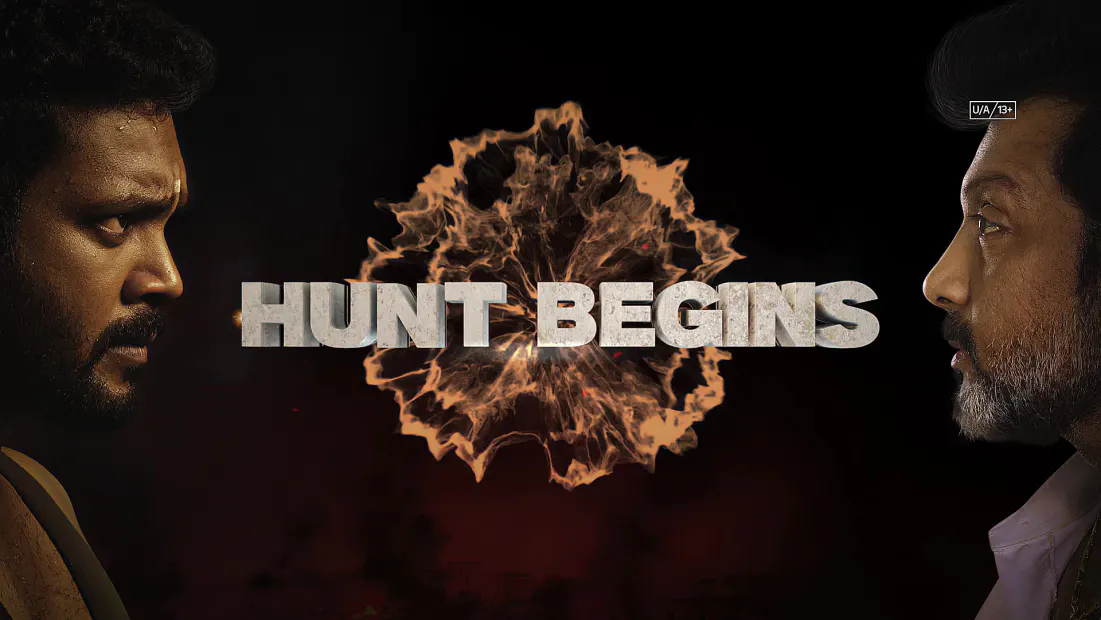
In 2025, as Tamil OTT platforms continue to expand their creative ambitions, “Veduvan” emerges as one of the most intriguing action dramas of the year. Released on Tamil Dhool on October 10, 2025, the series arrives with a compact but potent format—one season, seven episodes, a 13+ rating, and an impressive 7.7 OTTplay rating—yet its thematic reach extends far beyond its runtime.
At first glance, Veduvan appears to follow familiar territory: a gritty action narrative inspired by the life of an encounter specialist. But the series quickly reveals itself to be something more layered and self-reflexive. It is not only a story about violence, justice, and power, but also a meditation on cinema itself—on how stories are chosen, shaped, and sometimes distorted when they move from lived reality to the screen.
At the center of this narrative stands Sooraj, a struggling Tamil actor whose life changes when he is offered a role that promises both professional salvation and moral peril.
A Struggling Actor at the Crossroads
Sooraj is introduced not as a hero, but as an artist on the margins. He is talented, ambitious, and deeply frustrated—representative of countless actors who hover on the periphery of the industry, waiting for a break that may never come. His struggle is not glamorous. It is marked by rejection, compromise, and the quiet erosion of confidence that comes with prolonged uncertainty.
When a director approaches Sooraj with the opportunity to star in a biopic of Encounter Specialist Arun, the offer feels like fate intervening. This is not just a role; it is validation. A chance to step into the spotlight, to be seen, and to finally claim a place in an industry that often rewards connections over craft.
Yet Veduvan is careful not to romanticize this moment. From the outset, the offer carries an unspoken weight. Arun is not a conventional hero, and Sooraj senses that portraying him will require more than physical transformation or performance skill. It will demand moral reckoning.
Arun: The Myth and the Man
Encounter specialists occupy a complex place in Indian public consciousness. They are often celebrated as fearless enforcers of justice, men who operate where the law hesitates. At the same time, they are controversial figures, surrounded by allegations of extrajudicial violence, political manipulation, and moral ambiguity.
In Veduvan, Arun exists initially as a legend—an icon shaped by media narratives and public memory. The biopic that Sooraj is asked to headline seems, at first, poised to reinforce this mythos: a tough, uncompromising officer who delivers justice through the barrel of a gun.
But as Sooraj begins researching the role, the series pivots. The closer he gets to Arun’s story, the more cracks appear in the heroic façade. Testimonies conflict. Events refuse to align neatly. What seemed like clear-cut righteousness becomes clouded with doubt.
This gradual unraveling is where Veduvan finds its dramatic core.
A Story Within a Story
One of Veduvan’s most compelling narrative strategies is its meta-cinematic structure. The series is not merely about Arun; it is about the making of Arun’s story. By framing the narrative through Sooraj’s preparation for the biopic, the series invites viewers to question how truth is constructed in cinema.
What gets included in a film, and what gets left out? Who decides which version of events becomes “official”? And how much responsibility does an actor bear when embodying a real-life figure whose actions may have caused irreversible harm?
These questions are not posed abstractly. They emerge organically as Sooraj’s research deepens, pulling him into a moral labyrinth that mirrors the ethical grey zones of Arun’s career.
Action with Purpose
As an action series, Veduvan delivers intensity without excess. The violence depicted is purposeful, not ornamental. Each confrontation, chase, or gunfight is embedded within the narrative’s moral framework, reinforcing the idea that violence always leaves a residue—on its victims, its perpetrators, and those who later try to tell the story.
The action sequences are tightly choreographed, grounded in realism rather than spectacle. This approach aligns with the series’ broader commitment to authenticity. Veduvan is less interested in glorifying power than in examining its consequences.
The Psychological Toll of Immersion
As Sooraj immerses himself in Arun’s life, the boundaries between role and reality begin to blur. This psychological unraveling is one of the series’ most striking elements. The actor’s transformation is not limited to physical mannerisms; it seeps into his worldview, his relationships, and his sense of self.
The series explores a rarely addressed aspect of performance: the emotional cost of embodying morally compromised figures. For Sooraj, the role becomes a mirror reflecting uncomfortable truths—not only about Arun, but about ambition, complicity, and the price of success.
This internal conflict elevates Veduvan beyond conventional action drama, grounding its thrills in emotional and ethical tension.
Tamil Cinema Looking Inward
Veduvan arrives at a moment when Tamil cinema and OTT storytelling are increasingly willing to interrogate their own practices. By centering an actor as its protagonist and a biopic as its narrative engine, the series turns the lens inward, examining the industry’s relationship with power and representation.
The director character in the series—who initiates the biopic—embodies this tension. Is he a storyteller seeking truth, or a filmmaker chasing commercial success by packaging violence as heroism? The series resists easy answers, presenting filmmaking as a space where art, commerce, and ideology collide.
Compact Storytelling, Expansive Themes
With only seven episodes, Veduvan demonstrates the power of concise storytelling. There is little filler, no indulgent subplots. Each episode advances both the external plot and the internal transformation of its protagonist.
This economy of storytelling is particularly effective in the OTT format, where audiences value intensity and focus. The limited episode count allows the series to maintain narrative momentum while giving sufficient space for character development and thematic exploration.
Language, Identity, and Authenticity
Presented in Tamil, Veduvan remains firmly rooted in its cultural context. The language is not merely a medium of dialogue but a carrier of social nuance, power dynamics, and emotional texture. From the world of struggling actors to the corridors of authority occupied by encounter specialists, the series uses language to establish authenticity and depth.
This commitment to linguistic and cultural specificity enhances the series’ credibility, making its exploration of truth and power feel grounded rather than abstract.
Audience Reception and Impact
With a 7.7 OTTplay rating, Veduvan has been received as a thoughtful and ambitious addition to the Tamil OTT landscape. Viewers and critics alike have noted its willingness to engage with uncomfortable questions rather than offering simplistic resolutions.
Its 13+ rating reflects a balance between accessibility and maturity, ensuring that its themes reach a broad audience without diluting their seriousness.
More Than an Action Series
Ultimately, Veduvan is not just about guns, encounters, or biopics. It is about storytelling itself—about who gets to tell stories, whose voices are amplified, and how easily truth can be reshaped in the pursuit of success.
Sooraj’s journey is emblematic of a larger struggle: the tension between ambition and integrity. As he uncovers the darker layers of Arun’s story, he is forced to confront a question that resonates far beyond the screen: Is success worth the cost of silence or distortion?
Conclusion: A Mirror Held Up to Power and Performance
Veduvan stands out in 2025 as a rare action series that refuses to be consumed passively. By intertwining a gripping narrative with meta-commentary on cinema, morality, and power, it challenges viewers to think as much as they feel.
As a Tamil action drama released on Tamil Dhool, with one season of seven episodes, a 13+ rating, and a strong critical reception, Veduvan exemplifies the evolving potential of OTT storytelling. It proves that action can coexist with introspection, and that entertainment can be both thrilling and intellectually engaging.
In the end, Veduvan leaves its audience with a lingering unease—and that may be its greatest achievement. It reminds us that every story, especially those drawn from real lives, carries responsibility. And sometimes, the most dangerous encounters are not between cops and criminals, but between truth and the versions of it we choose to believe.