
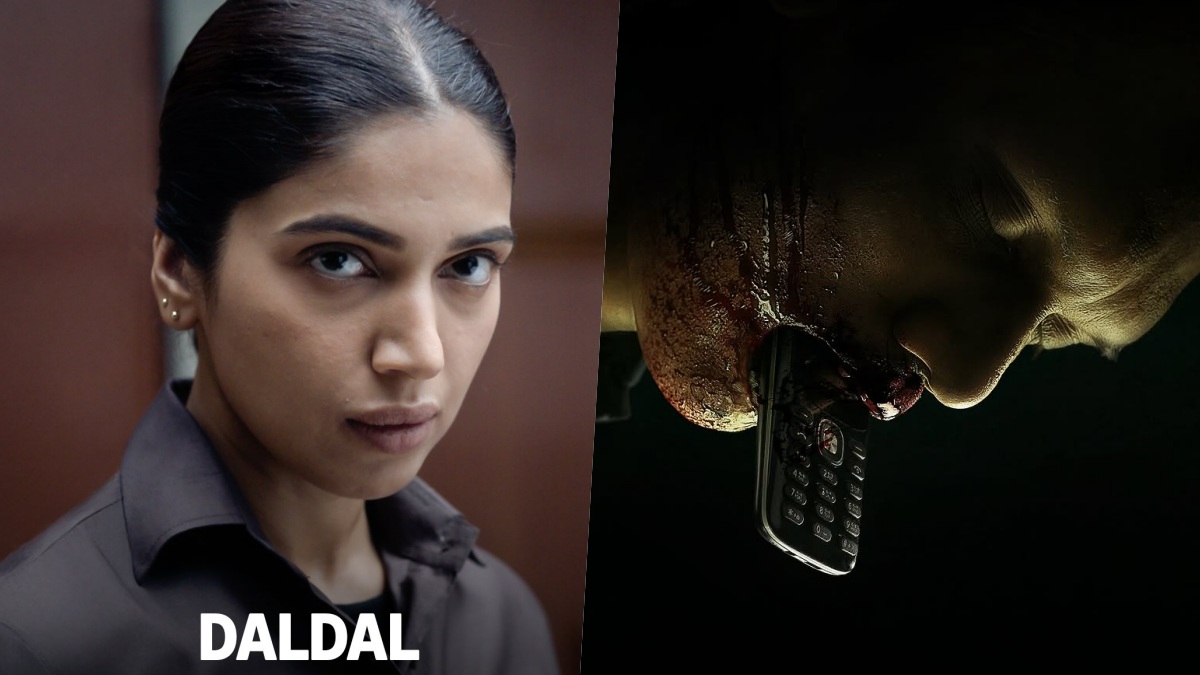
Daldal, a seven‑episode crime thriller streaming series created by Suresh Triveni and directed by Amrit Raj Gupta, arrives at a moment when the Indian web ecosystem is saturated with narratives of police procedurals, deeply scarred protagonists, and rituals of violence. On paper, the series seems poised to rise above the fray — blending psychological suspense with social commentary, setting its story in the teeming metropolis of Mumbai, and placing a complex female protagonist at its centre.
In execution, however, Daldal is a study in contrasts: an intriguing first act and an unusually bold opening choice are gradually overshadowed by heavy moral weight, contrived subplots, and a lead performance that, while committed, leans too much into bleakness and not enough into nuance. What remains is a series that often feels like it knows what it wants to say, but not always how to say it.
Mumbai in Pieces: Setting the Stage
The series opens with a flourish — not with an unseen killer stalking a victim, nor with a cryptic clue discovered in a dark alley, but with the killer revealed. This is a refreshing narrative choice. Right away, viewers know who the perpetrator is, a rare reversal of the typical “whodunit” structure. What follows is not so much a mystery about identity, but an exploration of motive, society’s blind spots, and the psychological toll of pursuing a predator everyone seems to know exists but no one can quite pin down.
Mumbai, as always in crime dramas, functions almost as a character in itself: a city of contrasts, equal measures of grit and glamour, wealth and grinding poverty, where the middle class struggles and the powerful exploit. Horns honk, people push through traffic, streets vibrate with energy and anxiety. It is a place where good intentions and ill will often blur.
But unlike other thrillers that lean into Mumbai’s cinematic romanticism, Daldal is unflinching in its portrayal of its more brutal underbelly. Here, violence isn’t a punchline. It’s systemic, ugly, and stubbornly unglamorous — a loud backdrop to an investigation that never feels clean.
Meet the Hunter: DCP Rita Ferreira
At the story’s core is DCP Rita Ferreira, portrayed by Bhumi Satish Pednekkar, who steps into her role with a palpable seriousness that sets the emotional tone for the series. Ferreira is newly appointed, and her first case is immediately explosive: a dog‑feeder she encounters by chance is discovered with his wrists slit and mouth crudely stuffed with raw meat. It’s a gruesome tableau — ritualistic, provocative, and laden with symbolism.
This killing is only the first in a string of similarly horrific murders: men of apparently respectable social standing, all slain in the same ritualistic fashion. The cumulative effect is unsettling, and Daldal earns points early on for its willingness to confront its audience with images that refuse to be ignored.
Ferreira’s team is a motley ensemble. There’s Geeta Agrawal Sharma as a junior officer whose earnestness provides intermittent levity; Chinmay Mandlekar as a resentful colleague who resents Ferreira’s promotion; and Sandesh Kulkarni, a senior officer whose support for Rita is complicated by his own motives. This bureaucratic tension — the sense that everyone within the department has an agenda — adds texture to an investigation that could otherwise feel procedural in a rote way.
When Archival Reality Meets Scripted Chaos
As the series unfolds, Daldal begins to tease out a web of interconnected subplots. A journalist, played by Samara Tijori, emerges as someone who seems to know more than she lets on, while a drug addict with murky ties to the previous case gives the narrative a strained but necessary edge.
The murders quickly start touching on uncomfortable social issues: paedophilia and drug abuse make unsparing appearances; a red‑light district thread winds through parts of the plot; a subplot involving an “encounters specialist” and a Russian sex worker highlights life on the margins; and other narrative arcs explore the devastation wrought by unfulfilled women who, in one instance, hurt their own daughters.
These individual slices of dysfunction could be piercing and potent, and at moments they are. There are scenes that linger in the mind — particularly those that depict the intersection of violence and childhood vulnerability, or the desperation of addicts seeking redemption where none seems available.
Yet the more the story progresses, the more these elements feel like separate jigsaw pieces not quite forming a coherent whole. Bizarre twists begin to crowd the main thread, distracting from the central investigation and creating a sense of narrative overload. Instead of enhancing the mystery, some sequences feel contrived — eye‑roll inducing rather than thought‑provoking.
A Performance Flat‑Lined
Perhaps the most significant challenge Daldal faces is its lead performance. Bhumi Pednekkar brings a brooding intensity to Rita Ferreira that clearly signals commitment — the character has reasons to be haunted, both by her predecessor and by the grotesqueries she encounters. But from episode to episode, Rita’s emotional palette rarely broadens beyond grim resignation.
For all her intelligence and drive, Ferreira comes off as excessively morose, as if perpetually carrying an internal monologue we never quite get to hear. When a character is suffering, the viewer should feel that suffering through them. In Daldal, however, Ferreira’s emotional landscape feels flattened — a monochrome cloud that hangs over the entire series without ever breaking into something more nuanced.
There is one moment when the script allows Pednekkar to crack — to let us see the woman beneath the badge — and in that brief window, we glimpse the performer’s true range. It is a shame that such moments are so rare. Meanwhile, actors like Tijori and Aditya Rawal (as the addict) are given more room to unsettle and intrigue. Geeta Agrawal Sharma brings a warmth to her supporting role that contrasts effectively with the show’s darker tones. Even Vibhawari Deshpande, in a smaller arc, leaves an impact.
Between the Personal and the Political
Daldal does something laudable: it refuses to limit itself to a simple killer hunt. It attempts to comment on the ecosystem that allows such violence to ripple through society. It tries to ask: What makes a city — and the institutions within it — capable of both protecting and failing its citizens? What does it mean when the monsters we chase are also products of the systems we uphold?
Yet these ambitions are only partially realized. In striving to interweave socio‑political commentary with sensationalist plot beats, the series often ends up diluting both. The commentary becomes too broad to be incisive, while the suspense — once promising — loses its urgency as the narrative expands in too many directions.
There is an irony here: a show about violence and fragmentation ultimately feels itself fragmented, never quite stitching its subplots into a tapestry strong enough to support its thematic heft.
Visual and Tonal Palette
Director Amrit Raj Gupta and his cinematography team craft images that are gritty and vivid, capturing Mumbai not as the postcard metropolis often seen on screen, but as a city worn by hardship, contradiction, and crushing density. Night scenes pulse with neon reflections in rain‑slicked streets; interiors of police stations feel claustrophobic; public spaces are shown as arenas where anonymity and danger coexist.
There are brief moments where the thriller format feeds into this visual language effectively — when silhouettes loom, when shadows pre‑empt fear, when silence itself holds tension. But the tonal control falters when the narrative shifts abruptly into scenes that feel tonally dislocated — comic relief one moment, grotesque horror the next, without a clear arc tying the shifts together.
Where Daldal Hits — and Where It Falters
Daldal is a bold first step in some ways. It does not shy away from difficult content. It places a female officer at the helm of a grisly investigation. It attempts to tackle issues that are socially uncomfortable, if not taboo. In theory, this is the kind of genre storytelling that can elevate the police procedural into commentary with real social purchase.
In practice, however, the series rarely sustains that promise. It begins with confidence, but as it unravels more ideas than it can cohesively explore, it becomes a cautionary example of the pitfalls of ambition without restraint. It shows, too clearly, how genre conventions can entrap creators when the script relies on familiar tropes — the haunted detective, the inexplicable killer, the inscrutable criminal mastermind — without grounding them in a psychological or thematic core that feels lived‑in rather than borrowed.
And while the performances around Pednekkar are strong, her own portrayal rarely gives us the inner life of her character in a way that redeems the uneven material.
Final Verdict
Daldal is an intriguing, uneven noir that occasionally sparks with genuine brilliance but ultimately gets bogged down under its own weight. It wants to be a textured, socially conscious serial killer investigation, and in parts, it almost achieves that. But the fragmented plotting, the inconsistent tonal shifts, and a lead performance that stays too comfortably in one emotional register leave the viewer wanting more depth and cohesion.
Yet there is value here — in the visual palette, in the supporting work, and in the series’ willingness to take on shadows most thrillers would rather gloss over. With a tighter script and sharper emotional throughline, this could have been the breakout show Mumbai’s crime genre desperately needs. As it stands, Daldal is a commendable experiment — ambitious, occasionally compelling, but at times frustrating in execution.
It’s not a bad show. It’s just not the great one it aspires to be.